Log-Periodic & Structured Wideband Antennas
Overview
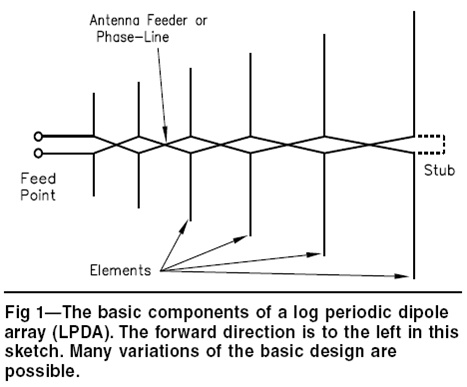
The directional wideband antenna family — LPDA, horn, spiral, Vivaldi, and equiangular spiral — delivers 4:1 to 10:1 frequency coverage with a forward directional pattern, combining the bandwidth of a discone with useful directional gain at the cost of element count and design complexity. This dive covers the LPDA (log-periodic dipole array, the EMC industry's 30 MHz – 1 GHz standard and the amateur "Yagi with bandwidth"), the horn (canonical microwave gain antenna above 1 GHz, 15–25 dBi in compact form at 2.4/5 GHz), the spiral and equiangular spiral (100:1+ bandwidth, circularly polarized, used in EW and GPS-spoof detection), and the Vivaldi (PCB-fabricated tapered-slot for UWB and SDR research). DIY build is a 400 MHz – 1 GHz LPDA from aluminum tubing.
Context
The use-case dividing line from the discone family is straightforward: omnidirectional wideband (discone) when the signal direction is unknown; directional wideband (LPDA or horn) when the direction is known well enough to point. LPDAs are the EMC industry's standard 30 MHz – 1 GHz emissions-test antenna and the hobbyist's "single feedline, multiple amateur bands, directional" choice. Horns take over above 1 GHz where waveguide flaring is mechanically compact. The LPDA vs Yagi decision turns on bandwidth requirements: same boom, same physical size — the Yagi wins on gain at one frequency, the LPDA wins across a 4:1 band.