Power, SWR & Field-Strength Measurement
Overview
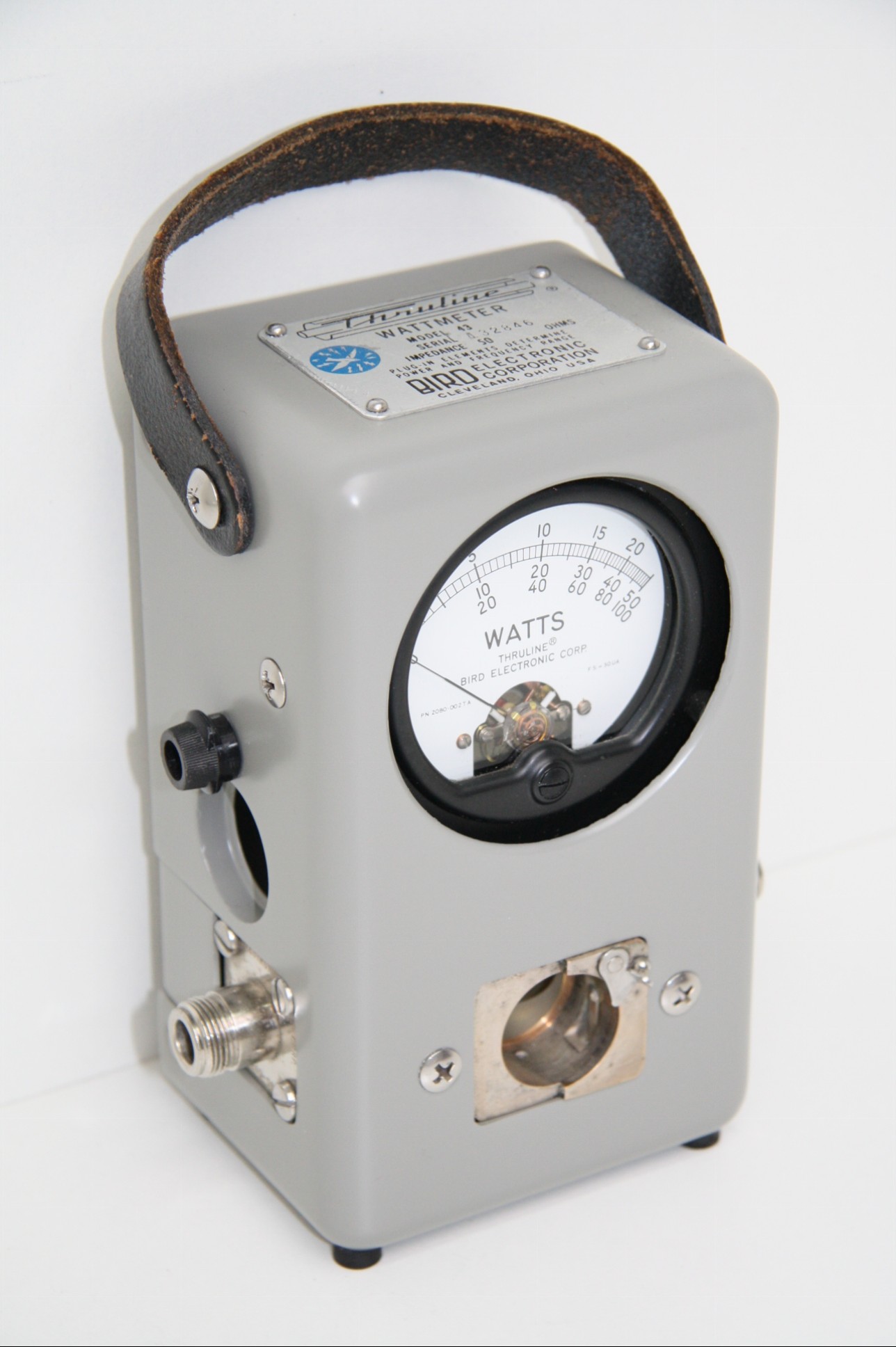
The VNA measures impedance ratios; this dive covers the complementary bench instruments that answer "how many watts is actually flowing, and how much of it is going where you want?" Through-line wattmeters (Bird 43 with its directional-coupler slug system — in production since 1953, still unimprovable for its purpose — and modern cross-needle SWR/power meters), dummy loads from 5 W QRP to 1.5 kW (including the 50 Ω 100 W DIY build from non-inductive resistors in an oil-filled enclosure), RF probes for high-impedance voltage measurement at circuit nodes (Tayloe RF probe DIY build), and four signal-generation paths — bench HP/Agilent/R&S sig-gens, HackRF/BladeRF as CW sources, NanoVNA port-1 as a fixed-frequency source, and ADF4351/ADF4355 cheap PLL synthesizer boards to 4.4 GHz. Field-strength meters and EIRP estimation by reciprocity bridge to the regulatory chapter.
Context
Antenna characterization without absolute-power instruments is incomplete: a NanoVNA confirms an EFHW presents 50 Ω on 40 m, but only a through-line wattmeter tells you whether the transmitter is actually delivering 100 W into it or losing 15 W to a bad connector center pin. The Bird 43's passive directional-coupler slug architecture is essentially unimprovable for the purpose — a 1965 unit with a fresh slug reads as accurately today as a new one. This dive completes the measurement-side toolkit alongside the NanoVNA and spectrum analyzer, addressing the absolute-power measurement gap that neither of those instruments fills.