Satellite Tracking
Overview
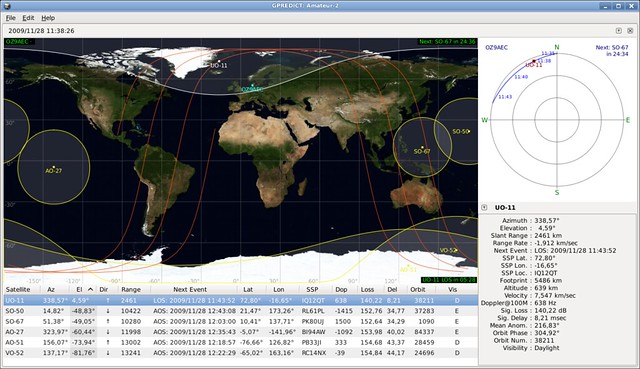
This dive derives the complete chain from orbital mechanics to rotator control: the two-body problem and its six classical Keplerian elements (semi-major axis a, eccentricity e, inclination i, RAAN Ω, argument of perigee ω, mean anomaly M at epoch), the two-line element (TLE) format that encodes those elements plus a drag term and an epoch for distribution, the SGP4/SDP4 propagator that carries TLEs forward through J2/J3/J4 oblateness perturbations and atmospheric drag to produce ECI position and velocity, and the ECI-to-topocentric rotation chain that yields azimuth, elevation, and slant range for a specific ground station. Doppler derivation (range-rate to frequency offset) closes the prediction side. The control side covers three rotator-drive paths: computer-driven via Hamlib/rotctld with Gpredict or SatPC32, a DIY K3NG/SatNOGS Arduino-based controller with MD-03 motor driver, and COTS controller boxes (Yaesu GS-232B, DCU-2, Alfa SPID RAU). Zenith-keyhole handling and CAT-driven Doppler correction are covered with worked LEO-pass and QO-100 examples.
Context
This is the software and mathematics complement to the Satellite Antennas & Rotators hardware dive. The explicit design requirement was "how the satellite coordinates are derived, what they mean, and software to help track them" — a demand for real orbital mechanics rather than a "just run Gpredict and trust it" black-box treatment. The math is carried to the level where the operator can check a tracking program's az/el output against a hand-computed prediction and understand why they agree or disagree. The Keplerian elements are explained geometrically, the SGP4 perturbations are named and their magnitude characterized, and the full ECI→topocentric transform is given with its rotation matrices so the derivation is a reference, not a mystery.