Discone & Wideband Antennas · Volume 4
The Rest of the Family
One impedance formula with a factor of two in it, a biconical that is twice the size the previous edition says it is, what the disc is actually for, and a section on sleeve antennas that names three products of which none can be shown to be a sleeve antenna
4.1 About this volume
The discone is one member of a family, and the family is held together by a single idea: a cone, fed at its apex, is a transmission line whose impedance depends on one angle. Everything in this volume is that idea with a different boundary condition attached. Put a conducting plane under the cone and you have a conical monopole. Shrink the plane to a disc and you have a discone. Remove the plane and put a second cone where its image was and you have a biconical. Flatten the biconical into two triangles on a sheet and you have a bow-tie.
The previous edition of this chapter covers all four, and its instincts about the relationships are sound — it correctly identifies the conical monopole as half a biconical, correctly identifies the bow-tie as a planar biconical, and correctly groups them. What it gets wrong is quantitative, and this volume’s corrections divide cleanly:
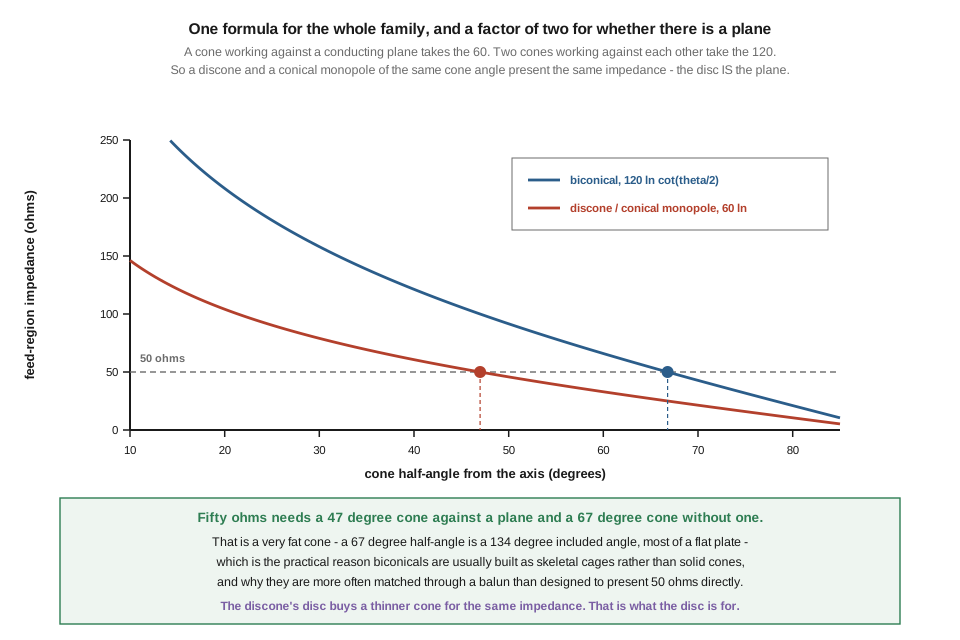
The impedance relationship has a factor of two in it that the chapter never states. §2 computes it. A cone against a plane and two cones against each other are the same structure with different symmetry, and the consequence is that a biconical needs a dramatically fatter cone to reach 50 Ω — 66.8° against the discone’s 47.0°.
The biconical is twice the size the chapter says it is. §3 draws all three to one scale. The chapter calls it “smaller than a discone at the same lowest frequency” in a sentence whose own parenthesis contradicts the word “smaller”.
And the sleeve section does not survive contact with its own products. §6 is the most serious finding in the volume. The chapter describes a sleeve antenna as a discone derivative and names three commercial examples; not one of the three can be shown to be a sleeve antenna, and one of them is verifiably something else entirely — checked against the manufacturer’s own store on 17 September 2026.
4.2 One formula, and whether there is a plane
Vol 1 §4 established the discone’s feed-region impedance as Z₀ = 60 ln(cot(θ/2)), with the disc acting as the image plane. The rest of the family follows immediately from what replaces that plane.
A conical monopole over a ground plane has the identical formula. The cone is working against a conductor exactly as before; a ground plane is simply a larger disc. So a conical monopole and a discone of the same cone angle present the same feed impedance — which is a fact neither the chapter nor, so far as this dive found, the amateur literature states plainly, and which is the cleanest way to see what the disc is doing.
A symmetric biconical has no plane at all, and takes twice the impedance:
Z₀ = 120 ln( cot(θ/2) )
The reason is the reason it always is for a dipole against a monopole: the monopole develops its voltage across one gap to an image, the dipole across two gaps in series, so the impedance doubles while the current stays the same. Wikipedia’s biconical article states the underlying property for the infinite case — “the characteristic impedance at the point of connection is a function of the cone angle only and is independent of the frequency” — and the discone is described there, correctly, as “a halved biconical – easier to construct and erect than a bicone.”
The practical consequence is large:
Table 1 — The practical consequence is large
| cone half-angle for 50 Ω | included apex angle | |
|---|---|---|
| discone / conical monopole | 47.0° | 94° |
| symmetric biconical | 66.8° | 134° |
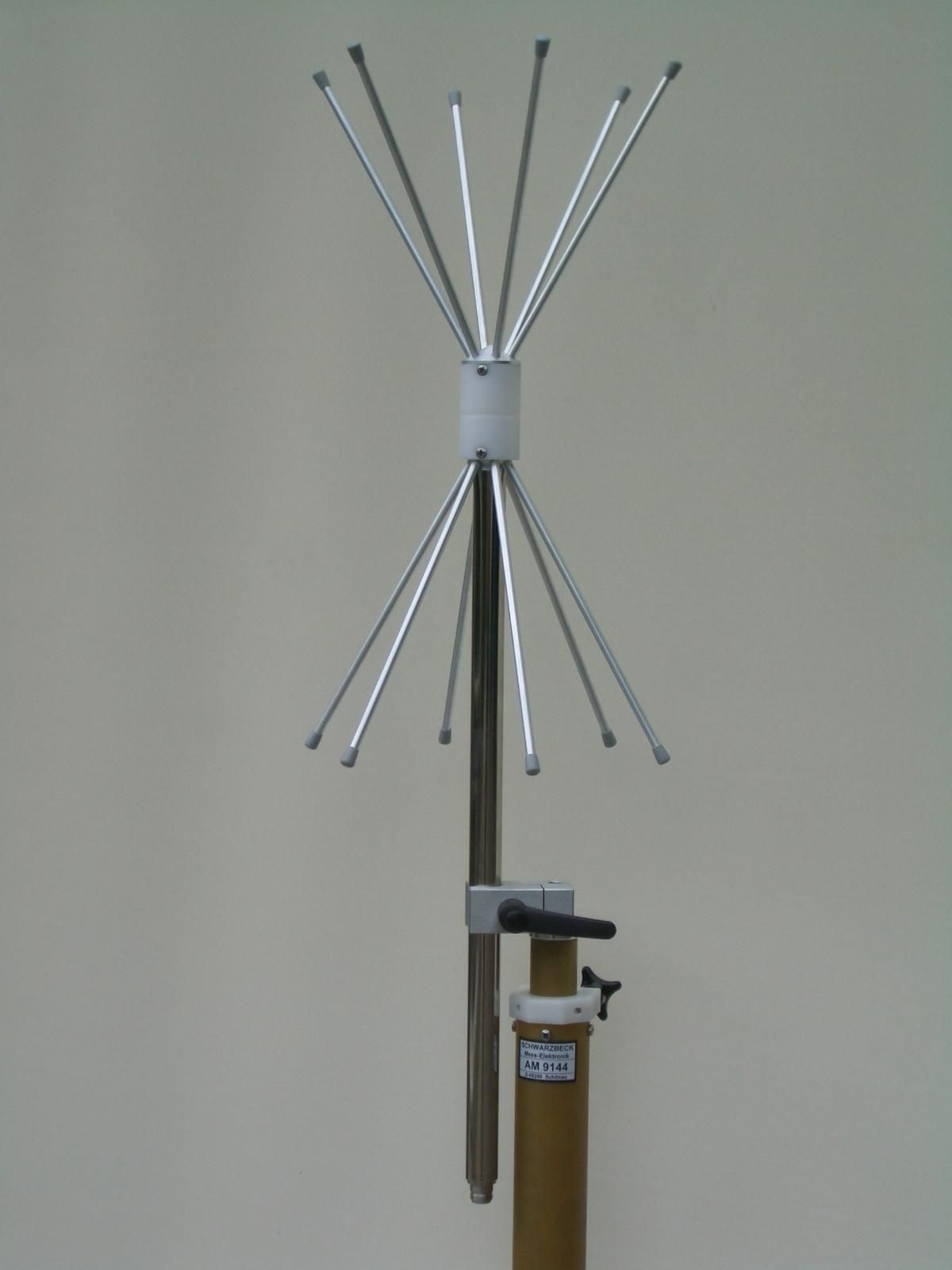
⭐ A 134° included angle is not really a cone any more. It is a shallow dish — most of the way to a flat plate — and it is the reason real biconicals are almost never built as solid cones of that proportion. They are built as skeletal cages of a handful of rods, at a much narrower angle, and then matched through a balun rather than proportioned to present 50 Ω directly. The Schwarzbeck instrument photographed in §7 carries its balun’s specification on its label for exactly this reason.
At the 30° that every practical discone uses, the two differ as expected: 79 Ω for the discone, 158 Ω for the biconical. A biconical built to discone proportions is a 158 Ω antenna, which is a 3.2:1 mismatch on 50 Ω coax and explains why the balun is not optional.
4.3 Size: the biconical is not the smaller one
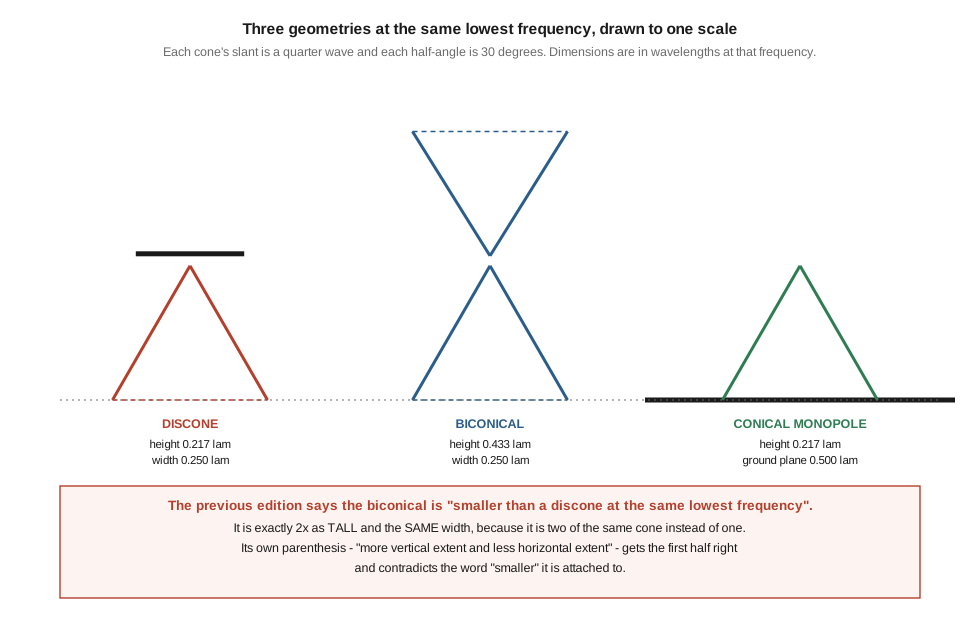
The chapter’s comparison:
- Smaller than a discone at the same lowest frequency (no disc means more vertical extent and less horizontal extent)
🔴 The headline is wrong and the parenthesis contradicts it. “Smaller” and “more vertical extent” cannot both be true of the same comparison, and the parenthesis is the half that is right.
Computing it. Each cone’s slant is a quarter wave at the lowest design frequency, so at a 30° half-angle one cone contributes 0.25 cos 30° = 0.2165 λ of height and 2 × 0.25 sin 30° = 0.2500 λ of width:
Table 2 — Computing it. Each cone's slant is a quarter wave at the lowest design frequency, so at a 30° half-angle one cone contributes 0.25 cos 30° = 0.2165 λ of height and 2 × 0.25 sin 30° = 0.2500 λ of width
| height | maximum width | |
|---|---|---|
| discone | 0.2165 λ | 0.2500 λ (disc is 0.1750 λ) |
| symmetric biconical | 0.4330 λ | 0.2500 λ |
| conical monopole | 0.2165 λ | 0.5000 λ of ground plane |
The biconical is exactly twice as tall and exactly the same width, because it is two of the same cone instead of one. There is no dimension on which it is smaller. The chapter’s “less horizontal extent” is also wrong — the cones are identical, so the horizontal extent is identical — but that error is minor beside the doubling.
⚠ Where the chapter’s intuition came from is worth reconstructing, because it is not baseless. A biconical is often described as compact relative to a discone, and in the EMC world it genuinely is the more portable instrument — a cage biconical folds into a case and a discone does not. But that is a statement about construction and packaging, not about electrical size at a common lowest frequency, and the chapter presents it as the latter.
4.4 The conical monopole, and what the disc is actually for
The chapter’s conical-monopole section is its best in this volume and mostly needs endorsing.
✅ “A conical monopole is a cone over a ground plane — half of a biconical, electrically equivalent to a full biconical (the ground plane acts as the image of the bottom cone).” Correct, and correctly reasoned. §2’s factor of two is the quantitative form of exactly this sentence.
✅ “Compact: ~half the height of a biconical at the same lowest frequency.” Correct — 0.2165 λ against 0.4330 λ, confirmed in §3. ⚠ Note that this is the same comparison the chapter got backwards two sections earlier when it ran the other way. It has the relationship right here and inverted there.
✅ “The conical monopole is sometimes used as the wideband element on a vehicle mast where the vehicle roof acts as the ground plane.” Correct, and the natural application. The portable and mobile monopoles dive covers how large a vehicle roof has to be, band by band, to serve as that plane.
What is missing is the answer to the obvious question, and §3’s table supplies it.
⭐⭐ The disc is a compact stand-in for a ground plane, and that is the discone’s entire contribution over the conical monopole. A ground plane needs radials of about a quarter wave to behave as one, which is 0.5 λ of diameter. The discone’s disc is 0.7 × 0.25 λ = 0.175 λ across — 35 % of the diameter, about an eighth of the area — and it does the job well enough that the feed impedance follows the same formula.
That is why the discone exists, why it is the form that got commercialised, and why it is the one bolted to chimneys rather than the conical monopole. It gets a ground plane’s impedance behaviour out of a part that is a third the size and needs no radials, no counterpoise and no vehicle roof. The chapter never states the advantage the whole antenna is built around, and its own sections contain both halves of it.
⚠ One caveat this dive can state but not quantify. The disc is a poor ground plane in one respect: being small, it does not screen the feedline from the radiating structure the way a real ground plane does, which is the mechanism behind the common-mode problem the chapter’s §6.3 correctly flags. That section’s recommendation — a ferrite choke at the feedpoint — is sound and is endorsed. How much current a discone actually puts on its coax braid was not established here and is a bench measurement.
4.5 The bow-tie
The chapter’s bow-tie section is short and is correct throughout, which is worth recording so a later pass does not re-open it.
✅ “A bow-tie antenna is the 2D planar version of a biconical: two triangles tip-to-tip on a flat plane.” Confirmed. Wikipedia: a bow-tie is “essentially a flattened version of the biconical design which is often used for short-range UHF television reception.”
✅ The applications listed — UHF television receive, printed ultra-wideband elements on circuit boards, small planar elements inside consumer enclosures — are all real and are the places bow-ties are actually found.
✅ And the pattern statement is right, in a dive where pattern statements have not been. The chapter says the bow-tie “is not an omnidirectional antenna in the same sense as the conical/biconical/discone — its pattern is figure-8 (similar to a dipole) with the polarization in the bow-tie’s plane.” That is correct: flattening the cones destroys the rotational symmetry that made the other three omnidirectional, so the azimuth pattern becomes a dipole’s. ⭐ This is the one place in the chapter where the consequences of a symmetry change are followed through properly, and it stands in instructive contrast to Vol 3’s elevation section.
The one thing worth adding is why a bow-tie is wideband at all, which the chapter leaves implicit: it inherits the biconical’s angle-defined geometry in two dimensions rather than three. It is the same Rumsey argument Vol 1 §3 made, with the same truncation caveat — the triangles have a length, so the structure has a bottom frequency.
4.6 The sleeve section, and three products that are not sleeves
This is the weakest section in the chapter and the finding is specific.
The chapter describes the sleeve antenna as a discone derivative:
A sleeve antenna takes the lower half of a discone (just the cone) and mounts it inverted over a metal sleeve forming a quarter-wave choke.
⚠ That does not match what the term denotes in the antenna literature, and this dive could not obtain a primary reference to settle the definition — so the terminology point is raised rather than asserted. What the phrase normally covers is a coaxial structure with no cone in it: either a sleeve dipole, where a quarter-wave conducting sleeve slid over the coax forms the lower half of a dipole while the exposed centre conductor forms the upper half, or a sleeve monopole, where a driven element is surrounded by a concentric sleeve fed at the sleeve’s upper lip. The geometry the chapter draws — a cone above a quarter-wave choke — is a conical monopole with a choke, which §4 has already covered under its own name.
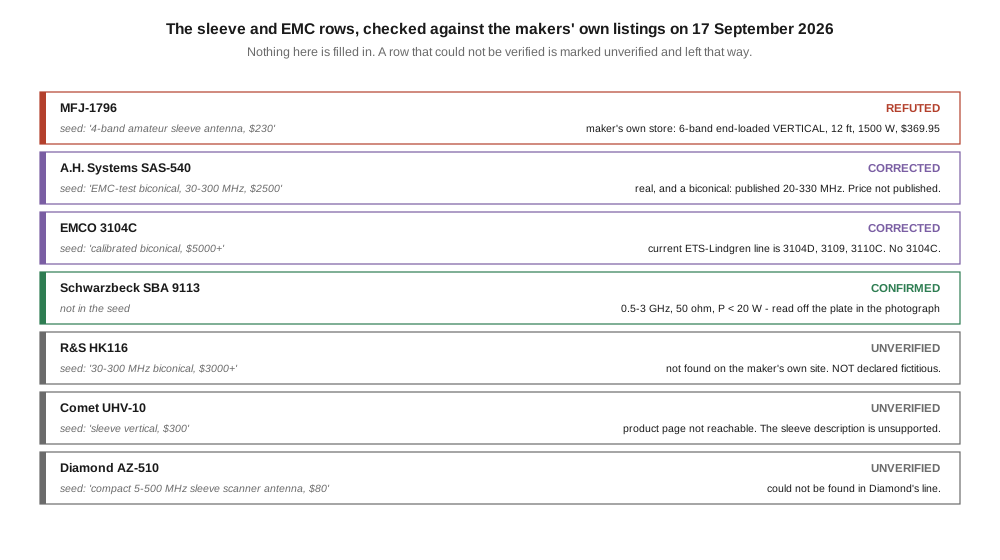
What can be established without adjudicating the definition is the state of the products, and it is decisive. The chapter names three commercial sleeve antennas. Checked on 17 September 2026:
🔴 MFJ-1796 — refuted on the manufacturer’s own store. The chapter calls it “a 4-band amateur sleeve antenna, $230”. MFJ’s own listing reads “MFJ-1796, VERTICAL ANTENNA, 6 BAND (2,6,10,15,20,40 METERS”, describes a 12-foot end-loaded vertical with automatic bandswitching and an air-wound choke balun, rates it at 1500 W PEP, and prices it at $369.95. That is wrong in four particulars: six bands not four, an end-loaded vertical not a sleeve, and a price 60 % above the one printed. ⚠ Note also that MFJ ceased manufacturing on 17 May 2024, so remaining stock is what is being sold.
⚠ Comet UHV-10 — could not be verified. The chapter gives “6/10/15/20/40 m + 50/144/430 MHz amateur sleeve vertical, $300”. Neither the manufacturer’s page nor the dealer listing could be reached. The UHV series is, so far as could be determined, a multi-band loaded vertical rather than a sleeve, but that could not be confirmed and is therefore not asserted. The row is marked unverified.
⚠ Diamond AZ-510 — could not be found. The chapter gives “a compact 5–500 MHz sleeve scanner antenna, $80”. No such model could be located in Diamond’s line. ⚠ It is marked unverified rather than declared fictitious, because declaring a real product imaginary is a named failure mode in this program and absence of evidence at three retailers is not proof.
⭐ So the section’s supporting evidence is: one product verified to be something other than a sleeve antenna, and two that could not be verified at all. That is the finding — not that sleeve antennas do not exist, which they plainly do, but that nothing in the chapter’s sleeve section is supported by the products it cites.
Two further claims in the section inherit defects from elsewhere:
🔴 The pattern claim carries Vol 3’s inversion. “Pattern: vertically polarized omnidirectional, peak elevation 20–35° (similar to a discone)” repeats the elevation error corrected in Vol 3, with the same wrong comparison attached.
⚠ The bandwidth claim is unsourced. “Bandwidth: 3:1 to 5:1” may well be right for a properly designed sleeve monopole, which is a genuinely broadband device, and would be far too generous for a plain sleeve dipole, which is not. Without a definition settled the figure cannot be evaluated, and it is left as the chapter’s claim rather than endorsed.
4.7 The EMC world, where a biconical is an instrument
The chapter is right that the biconical’s most prominent application is electromagnetic-compatibility testing, and right that this is where the calibrated examples live. Wikipedia confirms the category: biconicals “are often used in electromagnetic interference (EMI) testing either for immunity testing, or emissions testing.”
Its product rows need work, and the corrections run in both directions.
✅ A.H. Systems SAS-540 is real and is a biconical, contrary to what a reader of this dive’s other product audits might expect. A.H. Systems’ own catalogue describes it as “the standard workhorse of any EMC test house for emissions testing”. ⚠ Its published range is 20 MHz – 330 MHz, not the chapter’s “30–300 MHz”. ⚠ The $2,500 price could not be verified — A.H. Systems does not publish prices — and is marked unverified rather than repeated as fact.
⭐ The chapter also under-represents the line. A.H. Systems currently lists SAS-540, SAS-542, SAS-543, SAS-544, SAS-544F, SAS-545 and SAS-547, spanning 20 MHz to 18 GHz. The SAS-544F is rated at 300 watts, which is the only published power figure found for any antenna in this section and is worth having.
⚠ “EMCO 3104C” is a superseded designation. EMCO is now ETS-Lindgren, whose current biconical line is the 3104D, the 3109 and the 3110C. There is no 3104C in the present catalogue. This is a model that has moved on rather than one that never existed, and the chapter’s $5,000+ figure is unverified.
⚠ Rohde & Schwarz HK116 could not be verified on the manufacturer’s own site. It is a long-established model name and is not declared fictitious; the row is marked unverified and the $3,000 figure is not repeated.
⚠ The “Bilog” claim is partly confirmed. The chapter says the standardised EMC antenna is “the Bilog (a hybrid biconical + log-periodic)”. The hybrid is certainly real — A.H. Systems lists a “Bilogical Antennas” category, and Schwarzbeck’s VULB 9165 is described as a “LOGBICON Super Broadband test Antenna, (20) 30 – 1500 (2000) MHz, 10 W”. ⚠ That it is the standardised model is a claim about a test standard that this dive did not read, and it is left as the chapter’s. The hybrid’s directional half belongs to the log-periodic and structured wideband dive rather than here.
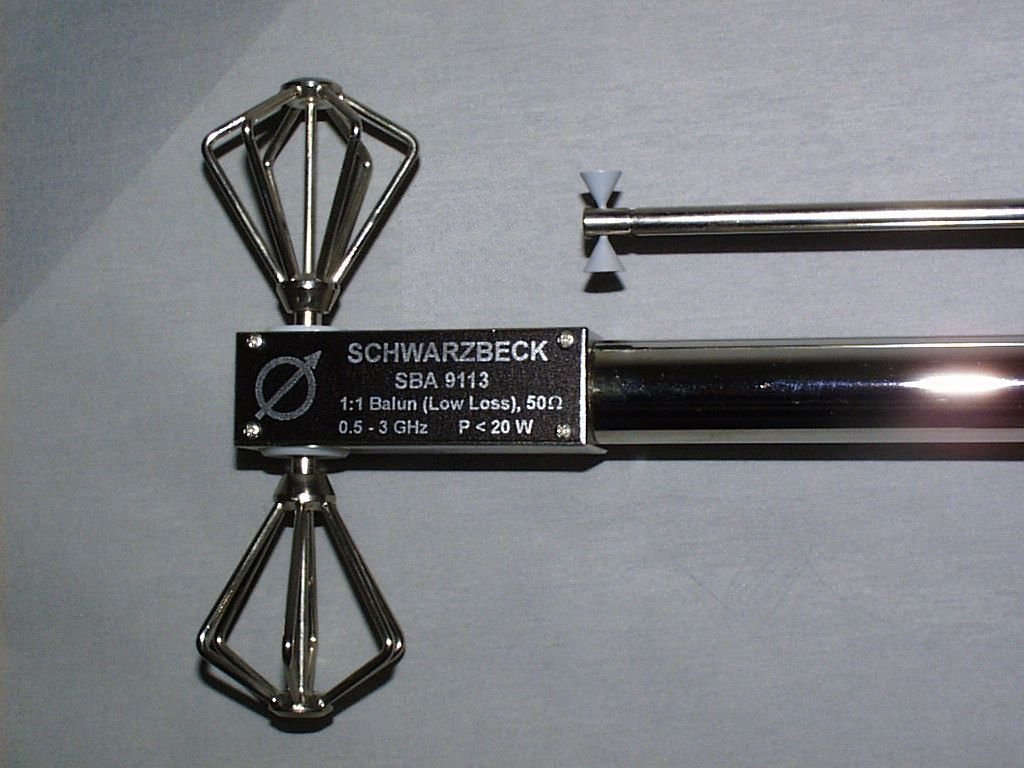
🔴 And the power figures need reversing. The chapter’s power table gives “A.H. Systems wideband discones | 500 W+ (commercial-grade)”, implying that instrument-grade construction means high power handling. The Schwarzbeck SBA 9113 photographed above carries its own rating on its plate, legible in the image and quoted from it directly: “1:1 Balun (Low Loss), 50Ω / 0.5 - 3 GHz / P < 20 W”.
⭐⭐ Twenty watts. An EMC biconical is a measuring instrument — it is calibrated, it has a stated antenna factor, and it is built for accuracy rather than for power. Immunity-testing antennas are driven hard and are built differently; emissions-testing antennas like this one spend their lives receiving. The chapter’s assumption that professional means rugged is precisely backwards for this class of antenna, and the correction matters to any reader tempted to buy a surplus EMC biconical for transmitting.
4.8 Where this volume hands off
The family is one structure with different boundary conditions, and the arithmetic follows from that.
A cone against a conducting plane takes 60 ln(cot(θ/2)); two cones against each other take twice it. So a discone and a conical monopole of the same angle are the same antenna electrically, and a biconical needs a 66.8° cone for 50 Ω against the discone’s 47.0° — a 134° included angle that is barely a cone, which is why real biconicals are cages matched through baluns. The biconical is exactly twice as tall as a discone at the same lowest frequency and exactly as wide, not smaller. And the disc is a ground plane at 35 % of the diameter, which is the discone’s whole reason for existing and the one thing the chapter never says.
The bow-tie section is correct throughout. The sleeve section names three products, one of which is verifiably an end-loaded vertical selling for 60 % more than the price printed, and two of which could not be verified at all. The EMC rows are a mixture: the SAS-540 is real with a slightly different published range, the 3104C has been superseded by the 3104D, the HK116 could not be verified and is not declared fictitious, and the assumption that instrument-grade means high-power is inverted — the biconical photographed here is rated under twenty watts.
From here:
- Vol 5 — Build, measure and buy builds the discone with Vol 1’s angle and Vol 2’s gap corrected, replaces a verification procedure that cannot fail, and completes the commercial survey with the discone rows this volume did not cover.
- The log-periodic and structured wideband dive takes the directional half of the wideband problem, including the log-periodic element of the hybrid EMC antennas §7 touches on.
Three things are owed. A primary reference for the sleeve antenna’s definition, without which §6’s terminology point stands as a question rather than a correction. The common-mode current a discone actually puts on its feedline, which §4 identified as the price of a small disc and could not quantify. And prices for the EMC instruments, which none of the three manufacturers publishes; those rows are marked unverified and should stay that way until a quotation is in hand.
4.9 Resources
- Wikipedia, Biconical antenna — the infinite-biconical impedance property §2 rests on, the bandwidth of “three octaves or more”, the EMI-testing application, the bow-tie as “a flattened version of the biconical design”, and the discone as “a halved biconical”.
- A.H. Systems, biconical antenna catalogue — the SAS-540 through SAS-547 line, the SAS-544F’s 300 W rating, and the “standard workhorse” description. Read 17 September 2026. No prices published.
- ETS-Lindgren, biconical antenna line — the 3104D, 3109 and 3110C, and the absence of a 3104C. Read 17 September 2026.
- MFJ Enterprises, MFJ-1796 listing — the six-band end-loaded vertical §6 refutes the chapter’s description against. Read 17 September 2026.
- Wikimedia Commons, Schwarzbeck RE 1790.jpg and SBA 9113 (side view).jpg, Schwarzbeck Mess-Elektronik, CC BY-SA 3.0 — the two biconical photographs, and the source of the 20 W rating quoted in §7, which is read off the instrument’s own plate in the image.
- Discone and wideband antennas, Vol 1 — the
60 ln(cot(θ/2))formula this volume doubles, and the truncation argument §5 applies to the bow-tie. - Discone and wideband antennas, Vol 3 — the elevation correction that §6’s sleeve pattern claim inherits.
- Portable and mobile monopoles, Vol 2 — how large a vehicle roof must be to serve as the ground plane §4’s conical monopole needs.
- Log-periodic and structured wideband antennas — the directional wideband family, and the log-periodic half of the hybrid EMC antennas.
Comments (0)